Showing posts with label earthday. Show all posts

Friday, May 8, 2020

A Stone Sat Still -- Perfect Picture Book Friday

I have been watching the birds in my backyard a lot. In the spring, we have many bird species that only stop by the feeders for a short time before moving on to their nesting grounds. There are also birds who stop coming to the feeder in spring as they are migrating to their nesting ground. I have been paying attention to the birds for several years. I noticed that the red-winged black birds come back in early spring. I used to think of them as summer birds because they would and still do sit on tall grasses in the summer sun and heat and trill all day. After paying attention, I realized that they are very early harbinger of spring. The robins come back a little later, and for a short time, flock into yards and open spaces as large groups looking for tasty meals. I suspect they love the rainy days and the worms coming up from the deep soil. And then the dark-eyed juncos who spend the winter foraging for seed under the bird feeders hang out until all chances of snowstorms are over. I begin to pay close attention to the juncos in March and hope each morning that they will be gone. For me they are a sign that the weather is really changing for the better. I love the juncos in the winter. Their little black and white bodies bop around under the feeders remind me that it may be cold out, but I am as resilient as a little bird so I can go outside too. In the spring, I am ready for warmth and the blooming of flowers and trees. 

Today I chose A Stone Sat Still because it is a poem to nature. A poem to paying attention and noticing things that seem simple and uninteresting, but are actually complex and exciting.
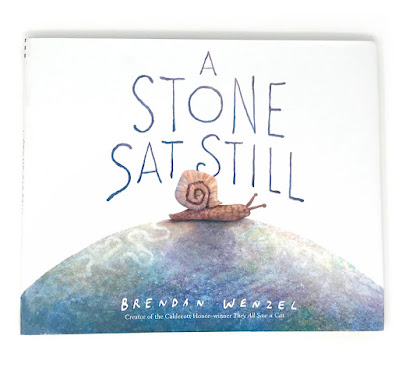
Cover Art for A Stone Sat Still
Title: A Stone Sat Still
Author/Illustrator: Brendan Wenzel
Publisher: Chronicle Books, 2019


Opening Page:
A stone sat still
with the water, grass and dirt

and it was as it was
where it was in the world.

Why I believe you will love this book:
  • It is lyrical and has a lovely repetition. 
  • This story is filled with discussion opportunities and doors to learning more about nature topics. 
  • The illustrations are made with cut paper, colored pencil, oil pastels, marker and the computer. They are soft and bright, wild and gentle.
  • It is a story about using your senses and thinking about size. You can hear the crack of the shell, feel the warmth of the day, and understand that perception of size depends on what is is around. 

And the stone was green     red (book images)

I am not doing this book justice. It is best enjoyed by just enjoying it. It is a book to sit with and ponder. It is the kind of book that catches your heart and holds on as a reminder of how special our world is.


Resources and Activities:


Brendan talks about the story behind this story. 


  • Spend time in the woods, in your yard, on a nature trail, by a river, lake stream, ocean, or at your window and just sit and watch. What do you see? Make a list, draw pictures.
  • What senses are you using as you watch? What senses are the animals, birds, insects using as they interact in the world? 
  • Write a poem about what you discover.
  • If a rock could talk, what do you think it would say about it's life experience?

  • Make a collage animal. 
  • Here's a link to loads of collage ideas.
  • Use found objects for you art. 
  • Play with watercolors and use the pieces to cut up and make a new piece of art.
  • Participate in Citizen Science projects. I have been adding my bird data to Ebird. I also participate in the Frog Calling Survey and will be doing a training on a pollinator project. I love it because I get to be in nature and hopefully help the wildlife by keeping track of the things I see.
  • Recently I started a little photography project that I call, "Nine things I Noticed."  I take lots of pictures with my phone when I walk my dog. I pull together nine of the cool things I love and put them together in the Instagram Layout App.  Here are two that I have created. 
    Nine weird and wonderful thing noticed on a walk.Nine Flowers I noticed on a walk
Well, nature and my dog are calling. Off to see what we notice today.

Support your Local Indie Bookstore when you purchase a book.

Check out Susanna Hill's Perfect Picture Book Friday Blog post each week to learn about more cool books to read with your kids and add to your collection.

Friday, May 1, 2020

Tiny Creatures -- Perfect Picture Book Friday

Earth Day Every Day!

Cover art for Tiny Creatures: The World of Microbes


Title: Tiny Creatures: The World of Microbes
Author: Nicola Davies
Illustrator: Emily Sutton
Publisher: Candlewick Press, 2014 (US)

Themes: Science, Second person, STEAM, Microbes

Opening Lines: You know about big animals, and you know about small animals . . .but do you know that there are creatures so tiny that millions could fit on this ant's antenna?

Why I believe you will LOVE this Book:

As we live through this Pandemic with Covid-19, microbes are taking a front seat in our fear and desire to understand. This picture book provides an understanding of microbes, the good, the bad, the pretty, and the ugly.

This book helps readers grasp the benefits and dangers of microbes. It helps us grasp that they come in many shapes and sizes. There are many more healthy microbes than the bad ones.

Emily Sutton's watercolor illustrations are beautiful and help to make a kind of scary topic less scary.


food into compost. Milk into yoghurt page

This is one of those books that you may not pick up on any old average day, but once you do pick it up, I think you will go back to it even when we have any old average days again.

rocks into soil page


Resources and Activities:

Here is a video of the book being read aloud.


An inspiring video interview with Nicola Davies.

Nicola's Website

Emily Sutton's Website

Learn more about Microbiology

This video is current and puts the health of our earth into relationship with the health of humankind.


Support your Local Indie Bookstore when you purchase a book.

Check out Susanna Hill's Perfect Picture Book Friday Blog post each week to learn about more cool books to read with your kids and add to your collection.

Friday, April 24, 2020

Four Otters Toboggan-- Perfect Picture Book Friday

It's EARTH WEEK!

Cover Art for Four Otters Toboggan

Title: Four Otters Toboggan: An Animal Counting Book
Author: Vivian Kirkfield
Illustrator: Mirka Hokkanen
Publisher: Pomegrante Kids, 2019

Themes: Nature, Counting, Conservation, STEAM, Earth Day

Opening Lines: 
Water waits.
Dawn breaks
in a chorus of bird song.

ONE willow flycatcher whistles
as the night slips silently away.

Text (c) Vivian Kirkfield, Illustration (c) Mirka Hokkanen, 2019

Why I Believe you will love this book:

Counting animals.

Text (c) Vivian Kirkfield, Illustration (c) Mirka Hokkanen, 2019

Poetry and the full circle of the day. A great story to read as you begin and end the day.

Text (c) Vivian Kirkfield, Illustration (c) Mirka Hokkanen, 2019

A theme of conservation with specific animals offers children a deeper look into the natural world allowing them to see the beauty and understand the need to care for the earth.

The art is beautiful. Mirka's printmaking is filled with detail and gentle colors that pull you in like the beauty of a new day. As they say "Earth without Art is just, Eh!" -- Demetri Martin

This is a lovely, simple, yet complex story that can be read to children of all ages. 

Activities and Resources:

  • Be sure to read the backmatter and learn more about each animal in the story.


  • Check out the activity guide. It is chock full of great things to do.


  • Watch Mirka making prints for the book:


  • Go on a scavenger hunt to see how many insects, mammals, and birds you see. 


Support your local Indie Bookstore when you purchase a new book.

Check out Susanna Hill's Perfect Picture Book Friday Blog post each week to learn about more cool books to read with your kids and add to your collection.

Friday, April 17, 2020

We Are Water Protectors -- Perfect Picture Book Friday

It is Earth Month and April 22nd is Earth Day, the 50th anniversary. Every Day is Earth Day. This is our planet and we need to care for it each and every day. We Are Water Protectors is brand new and it is a poem and prayer for our earth and the water that gives us life.


Cover Art for We are Water Protectors

Title: We Are Water Protectors
Author: Carole Lindstrom
Illustrator: Michaela Goade
Publisher: Roaring Book Press, 2020

For Ages: 4 and Up

Themes: Earth, Water, Native Peoples, Protests

Opening lines: 
Water is the first medicine, Nokomis told me.
We come from water.
It nourished us inside our mother's body.
As it nourishes us here on Mother Earth.
Water is sacred.

Why I LOVE this book and think you will too:

Somehow throughout my life, I have been introduced to many Native People's and learned a little bit about their cultures. Their stories have given me a love of the earth and an appreciation of the people and their connection to the world.

This book is a beautiful connection to the stories, the people, and our need to connect with mother earth. It is a call to arms to protect our planet and the water that gives us life.

It is a prayer for the earth.

Michaela's illustrations are like a dream. They show the beauty and the horror in contrast to each other as poetically as the words written by Carole.

This book makes me want:  To read it over and over again. To linger on each image. To glide my fingers across the colors and the water. To hold it close to my heart to remind me of what is truly important in life. To push me to stand up and fight for what is right.

I hope it does the same for you and your children.

Listen to Carole Lindstrom Read the book


Activities and Resources:

Check out Carole's website.

Image from the book
https://www.michaelagoade.com/about

Go outside, dig in the dirt, play with water. Plants seeds, a tree, and flowers.

Play with watercolor paints.

Learn more about the complaints and concerns regarding the Dakota Access Pipeline

More on the Pipeline

Learn about the Native American cultures where you live.

Take Action.
Pick up garbage left behind.
Attend a rally.
Make signs.
Write to your government officials.
Change one little thing like giving up straws and balloons.

OK, I am off to listen to Matthew Winners Podcast interview with Carole and Michaela. You can too.

Looking for more great books to read with your kids. Be sure to check out Susanna Hill's Perfect Picture Book Friday Blog Post.

Friday, January 10, 2020

Thanku: Perfect Picture Friday


Cover art for Thanku Poems of Gratitude

Title: Thanku: Poems of Gratitude
Illustrated by: Marlena Myles
Edited by: Miranda Paul
Publisher: Millbrook Press, 2019

Opening Poem, First stanza:

Giving Thanks
by Joseph Bruchac
In Memory of Chief Jake Swamp

Thanksgiving is more
than just one day,
so a Mohawk elder
said to me.

It feels fitting to begin 2020 with a book of poems about gratitude and thanks. I have spent a lot of time reviewing the last year and planning for the year ahead. Part of that project included acknowledging everyone I am grateful The list is long and it includes, family, friends, mentors, animals, and nature.

If you listen to Matthew Winner's podcast (Matthew is a person who I am grateful to have met this past summer), you will hear the poets say whether they pronounce the name of the book Than-ku or Thank You. From the first time I saw this book, I pronounced it Thank You, but as Matthew said, It is like Thanks and Haiku. Any way you say it the book is filled with beautiful poems of gratitude and and illustrations that add even more life to each poem created by Marlena Myles.

Miranda Paul is another person for whom I am grateful. She is the editor of this book. She is one of the first authors I met when I began my writing journey three years ago.

I am grateful for each poet, for the illustrator, for the editors, art directors, and publisher of this book.

As you read the poems  you will see and read that each is written in a different style of poetry. On the page of the poem, there is a small note on which style of poetry was used. At the back of the book, the poetic forms and literary devices are explained.

The poets are from many cultures. There are short bios about each at the back of the book.

I love this book, because it is beautiful in words and illustrations. It is like holding the world in your hands as you read. It is a book to read slowly. Savor each poem. Let it sink in. Enjoy the illustrations. Open it to any page and read what is there. Come back again and again.

Activities

  • Check out the back matter in the book to learn more.
  • Try writing your own poems in the various styles.
  • Make a list of all the things you are thankful for.
  • Send thank you notes.
  • Make thank you notes and deliver them in person.
  • Share kindness. 
    • The Kindness Rocks Project is cool.
    • When I was shopping before the holidays, I went to Aldi where you have to put a quarter in the slot to use a shopping cart. I rarely need a cart, but this day I had a pretty big list and no quarter. A woman offered me the cart and said, I always pay it forward, take the cart. I like to pay-it-forward as well. When I was done shopping, I passed the cart on to another person getting ready to shop. I imagine that everyone who arrived as that cart was being put away, was greeted by a kind person paying it forward. 
    • At the Farm and Fleet, I was at a loss for stocking gifts for my husband. I asked a person for some ideas of gadgets to go with a couple tools that he had. The man took me down the aisle and told me about several fun options. In our busy days, it's easy for someone to say here's where those accessories are and then walk away, but he went above and beyond so I could make choices quickly and easily as well as have a fun conversation.
    • Yarn Bombing
    • So many possibilities, so little time.
  • Learn the truth about the First Thanksgiving. See links under resources for excellent articles and lessons.
  • Celebrate diversity in your neighborhood, your community, your city, your school, and your home.
  • Buy this book and give it to someone who has been kind to you. Buy this book for yourself and read it over and over

Links to Resources from the book:
https://americanindian.si.edu/sites/1/files/pdf/education/thanksgiving_poster.pdf

https://americanindian.si.edu/nk360

https://americanindiansinchildrensliterature.blogspot.com/2015/11/dear-teachers-open-letter-about-images.html

https://americanindiansinchildrensliterature.blogspot.com/2015/11/dear-teachers-open-letter-about-images.html

You can listen to many of the authors talk about their poems at Matthew Winner's Children's Book Podcast

https://www.poetryfoundation.org/

One of my first experiences with Native peoples, was with Chief Oshkosh in Door County. Attending Powwows, hearing the music, the stories, and watching the dances by the light of the bonfire are a part of me forever. Those nights are a big part of who I am today.

I hope you will take any opportunity that arises to learn more about the Native American culture and let it mix in with you and your soul. Take time to learn about all cultures and all people. Love them for who they are. Give thanks for how their life experiences expand your life and make you a more loving and peaceful person.

Be sure to check out Susanna Hill's blog to find more Perfect Picture Book Friday posts. By the way, I am so grateful to Susanna for hosting her blog with #PPBF, Would You Read It Wednesday, Debut Tuesday, and her fun writing contests.

Friday, April 26, 2019

Perfect Picture Book Friday -- Dear, Agnes

Seventy-one percent of the earth's surface is made up of water. So for the last week of Earth Month, I take you to the ocean.

Book cover for Love, Agnes by Irene Latham


Title: Love, Agnes: Postcards from an Octopus

Author: Irene Latham
Illustrated by: Thea Baker

Publisher: Millbrook Press, 2018

Themes: Octopuses, STEAM, letter writing, problem solving, Earth Month

Opening lines: One day in the deep dark beneath the pier, an octopus found a large jar. She knew it would make the perfect home. But something was blocking her way.

Book Synopsis: When Agnes searches a new home, she discovers a postcard which she believes is calling her a monster, so she writes back to the author to set octopus facts straight. Thus begins the story of the giant Pacific octopus life cycle along with some ideas on how to handle uncomfortable situations.


Why I love this book:

I love epistolary stories. I loved the Jolly Postman books by Janet and Allan Ahlberg and the adult series Griffin & Sabine by Nick Bantock. Love, Agnes the one problem that the other books always caused in a library; no envelopes of flaps to get torn. But it has the same feeling of being a part of the story as you read the postcards.

Octopuses are so cool! Agnes is an older octopus and it's a story about the end of her life. This is a part of the life cycle that we often gloss over, but it is ever present. Like the Monarch butterfly who lives to lay eggs and create new life before dying, so too does the giant Pacific octopus. 

Mixed into this life of the octopus story is another story about dealing with things that bother us. Andrew's mother tells him that rather than get angry and act out, he should write it down. Little did he know that answers to his problems would come from an octopus.

Illustrations: They are beautiful. So many colors, patterns, and depth.


Epistolary defitintion


An artist I know, Betsy Mitten, combines art and science in her after school programs. One of the projects the kids do it is make Gyotaku prints with fish and octopus. It's fascinating and allows a child to see the details of the octopus and make art.


Octopus at the Maui Ocean Center
Can you find the octopus?
Finally, if you want to find more cool picture books check out Susanna Hill's Blog where you can look for reviews by book, title, and by themes.

Friday, April 19, 2019

Perfect Picture Book Friday -- Lost Words

April is Earth Month and National Poetry Month. Two things that go together as well as peanut butter and chocolate, tacos on Tuesday, rain and rainbows, worms and soil, flowers and sunshine . . . you get my drift. 

Today's Perfect Picture Book doesn't fit squarely in the picture book category of books. It's 128 pages and the acrostic poems require time and thought to allow their words and meaning to sink in and take hold of your heart and mind.  Yet, it is filled with beautiful illustrations and is a non-fiction poetry picture book.

For me, it conjures up the Wild Flowers of America book that sat on our book shelf as I was growing up (see image at the end of this post). I would browse the pages on rainy days, make drawings of the flowers with my crayons and paper, and even occasionally use it as the reference tool it was designed to be. So while neither are traditional picture books, they are books that take you into nature and without being pushed or prodded, your own imagination is sparked.

The Lost Words Book Cover

Title: Lost Words: A Spell Book

Author: Robert MacFarlane
Illustrator: Jackie Morris

Publishing Information:  2017 in the UK by Penguin Books Ltd. and 2018 in Canada and US by House of Anasasi Press Inc.

Ages: 0 - 100

Description from Amazon: In 2007, when a new edition of the Oxford Junior Dictionary ― widely used in schools around the world ― was published, a sharp-eyed reader soon noticed that around forty common words concerning nature had been dropped. Apparently they were no longer being used enough by children to merit their place in the dictionary. The list of these “lost words” included acorn, adder, bluebell, dandelion, fern, heron, kingfisher, newt, otter, and willow. Among the words taking their place were attachment, blog, broadband, bullet-point, cut-and-paste, and voice-mail. The news of these substitutions ― the outdoor and natural being displaced by the indoor and virtual ― became seen by many as a powerful sign of the growing gulf between childhood and the natural world.
Ten years later, Robert Macfarlane and Jackie Morris set out to make a “spell book” that will conjure back twenty of these lost words, and the beings they name, from acorn to wren. By the magic of word and paint, they sought to summon these words again into the voices, stories, and dreams of children and adults alike, and to celebrate the wonder and importance of everyday nature. The Lost Words is that book ― a work that has already cast its extraordinary spell on hundreds of thousands of people and begun a grass-roots movement to re-wild childhood across Britain, Europe, and North America.

Opening Lines: Once upon a time, words began to vanish from the language of children. They disappeared so quietly at first almost no one noticed -- fading away like water on the stone.

Why I love this book: I first read about this book in a post from the Children in Nature Network. Sadly, that post slipped my mind until a friend shared an article about the book with me a couple months ago. I immediately ordered it. Each time I open the pages, I turn them with awe and reverence. The title on the cover is gold embossed and the cover illustrations are a small sample of the beauty that is held within the pages.

Each lost word is given three double page spreads. The opening spread for the word is a letter jumble with the letters of the word in a unique color. The second spread includes an acrostic poem on the left and a watercolor illustration of the word on the right. The final spread is a scene depicting the word in its surrounding world.

A book worthy of book cases everywhere. Each word can become an adventure to the outdoors.

The poems are deep and full of mystery and love.

It is a book you can look at and read over and over again.

Activities and Resources:

Activities and and Explorer's Guide from the John Muir Trust

Writing Acrostic Poems

More about Acrostic Poems and using the word at the beginning, middle and end of each line.

Make a flower chain crown

Nature Journaling for Kids

Wet on wet Watercolor Painting

Bird Identification

The book from our family book shelf.

Wildflowers of America Book Cover

My Acrostic poem from this mornings visit of nine turkeys:

Tom Turkey strutting his feathers for a hen


Tom turkey struts his stuff
Under the bird feeders.
Rugged feathers raised, puffed, and shimmering in the morning light.
Kingly posture ignored by the ladies.
Every turkey more interested in breakfast,
Yet Tom persists hopefully.

Finally, if you want to find more cool picture books check out Susanna Hill's Blog where you can look for reviews by book, title, and by themes.

Friday, April 12, 2019

Perfect Picture Book Friday: Flowers Talk


Monarch Butterfly drinking nectar from purple asters photo by Sarah Tobias

You probably know that milkweed is very important to monarch butterflies because that's where they lay their eggs and then the caterpillars eat the leaves to grow big and strong so they can become butterflies. When it comes to quenching a butterflies thirst, they enjoy the nectar of many different types of flowers.

Flower Talk: How Plants Use Color to Communicate


Book Cover for Flower Talk by Sara Levine


Author: Sara Levine (www.saralevinebooks.com)
Illustrated by: Masha D'Yans (www.masha.com)

Published by: Millbrook Press, 2019

Themes: STEM,  Flowers, Nature, pollination

Ages: 6 - 11

Synopsis: A grouchy cantankerous cactus (prickly pear variety) tells the audience about how flowers use their colors, shapes, and scents to attract insects, birds, and and even mammals to help them make their seeds.

First Lines: "Hey, you! Pssst! Down Here! That's right -- I'm a plant, and I'm talking to you! But don't get too used to it. We don't make a habit of talking to humans."

Why I love this book: Pollinators are all the rage these days. We do need to save the bees and butterflies so it's a good thing we are talking about it! This books looks at the ecosystem and food web from the point of view of the flower and the symbiotic relationship between flowers and pollinators. It helps us understand the role that flowers and plants play in in the food web. This non-fiction story that will make you look at flowers in a new way.

Masha's watercolor illustrations are bright and exciting. The cactus narrator's prickly personality comes through on each page.

Excellent backmatter about flower pollination.

And really, talking to plants is fun. We should do it more often. You never know what you will discover.

A Q&A with Sara Levine

The blog post where I learned about this book.

Activities:

Create your own flower or nature scavenger hunt. Use the same one each season and see what things are the same and what things are different.

Take a hike in your local parks or forest preserves.

Start a Nature Journal

Play with watercolors. I found this little Nature Sketchbook that is easy to take with me and works well with all types of art mediums. Great for making art on the go or as a nature journal. I love this little watercolor set because it's easy to take with you and has lots of colors. A watercolor brush that holds water makes painting on the go super easy.

Make your own pollinator garden or participate in a local community garden.
A pollinator garden can be as small as a pot of native plants on your balcony or front porch. Make sure that you choose flowers that are native to where you live. Those flowers will provide the best food sources for native insects and birds.

drawing of a Nasturtium Fairy by Sarah Tobias

And . . . If you want to find more cool picture books check out Susanna Hill's Blog where you can look for reviews by book, title, and by themes.