Showing posts with label nature. Show all posts

Friday, May 8, 2020

A Stone Sat Still -- Perfect Picture Book Friday

I have been watching the birds in my backyard a lot. In the spring, we have many bird species that only stop by the feeders for a short time before moving on to their nesting grounds. There are also birds who stop coming to the feeder in spring as they are migrating to their nesting ground. I have been paying attention to the birds for several years. I noticed that the red-winged black birds come back in early spring. I used to think of them as summer birds because they would and still do sit on tall grasses in the summer sun and heat and trill all day. After paying attention, I realized that they are very early harbinger of spring. The robins come back a little later, and for a short time, flock into yards and open spaces as large groups looking for tasty meals. I suspect they love the rainy days and the worms coming up from the deep soil. And then the dark-eyed juncos who spend the winter foraging for seed under the bird feeders hang out until all chances of snowstorms are over. I begin to pay close attention to the juncos in March and hope each morning that they will be gone. For me they are a sign that the weather is really changing for the better. I love the juncos in the winter. Their little black and white bodies bop around under the feeders remind me that it may be cold out, but I am as resilient as a little bird so I can go outside too. In the spring, I am ready for warmth and the blooming of flowers and trees. 

Today I chose A Stone Sat Still because it is a poem to nature. A poem to paying attention and noticing things that seem simple and uninteresting, but are actually complex and exciting.
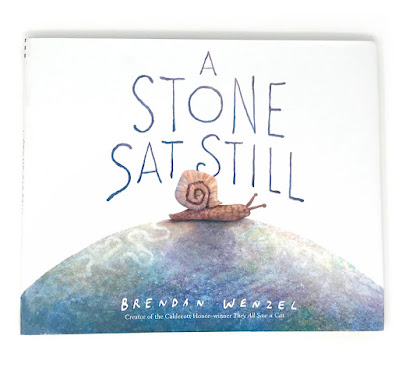
Cover Art for A Stone Sat Still
Title: A Stone Sat Still
Author/Illustrator: Brendan Wenzel
Publisher: Chronicle Books, 2019


Opening Page:
A stone sat still
with the water, grass and dirt

and it was as it was
where it was in the world.

Why I believe you will love this book:
  • It is lyrical and has a lovely repetition. 
  • This story is filled with discussion opportunities and doors to learning more about nature topics. 
  • The illustrations are made with cut paper, colored pencil, oil pastels, marker and the computer. They are soft and bright, wild and gentle.
  • It is a story about using your senses and thinking about size. You can hear the crack of the shell, feel the warmth of the day, and understand that perception of size depends on what is is around. 

And the stone was green     red (book images)

I am not doing this book justice. It is best enjoyed by just enjoying it. It is a book to sit with and ponder. It is the kind of book that catches your heart and holds on as a reminder of how special our world is.


Resources and Activities:


Brendan talks about the story behind this story. 


  • Spend time in the woods, in your yard, on a nature trail, by a river, lake stream, ocean, or at your window and just sit and watch. What do you see? Make a list, draw pictures.
  • What senses are you using as you watch? What senses are the animals, birds, insects using as they interact in the world? 
  • Write a poem about what you discover.
  • If a rock could talk, what do you think it would say about it's life experience?

  • Make a collage animal. 
  • Here's a link to loads of collage ideas.
  • Use found objects for you art. 
  • Play with watercolors and use the pieces to cut up and make a new piece of art.
  • Participate in Citizen Science projects. I have been adding my bird data to Ebird. I also participate in the Frog Calling Survey and will be doing a training on a pollinator project. I love it because I get to be in nature and hopefully help the wildlife by keeping track of the things I see.
  • Recently I started a little photography project that I call, "Nine things I Noticed."  I take lots of pictures with my phone when I walk my dog. I pull together nine of the cool things I love and put them together in the Instagram Layout App.  Here are two that I have created. 
    Nine weird and wonderful thing noticed on a walk.Nine Flowers I noticed on a walk
Well, nature and my dog are calling. Off to see what we notice today.

Support your Local Indie Bookstore when you purchase a book.

Check out Susanna Hill's Perfect Picture Book Friday Blog post each week to learn about more cool books to read with your kids and add to your collection.

Friday, April 24, 2020

Four Otters Toboggan-- Perfect Picture Book Friday

It's EARTH WEEK!

Cover Art for Four Otters Toboggan

Title: Four Otters Toboggan: An Animal Counting Book
Author: Vivian Kirkfield
Illustrator: Mirka Hokkanen
Publisher: Pomegrante Kids, 2019

Themes: Nature, Counting, Conservation, STEAM, Earth Day

Opening Lines: 
Water waits.
Dawn breaks
in a chorus of bird song.

ONE willow flycatcher whistles
as the night slips silently away.

Text (c) Vivian Kirkfield, Illustration (c) Mirka Hokkanen, 2019

Why I Believe you will love this book:

Counting animals.

Text (c) Vivian Kirkfield, Illustration (c) Mirka Hokkanen, 2019

Poetry and the full circle of the day. A great story to read as you begin and end the day.

Text (c) Vivian Kirkfield, Illustration (c) Mirka Hokkanen, 2019

A theme of conservation with specific animals offers children a deeper look into the natural world allowing them to see the beauty and understand the need to care for the earth.

The art is beautiful. Mirka's printmaking is filled with detail and gentle colors that pull you in like the beauty of a new day. As they say "Earth without Art is just, Eh!" -- Demetri Martin

This is a lovely, simple, yet complex story that can be read to children of all ages. 

Activities and Resources:

  • Be sure to read the backmatter and learn more about each animal in the story.


  • Check out the activity guide. It is chock full of great things to do.


  • Watch Mirka making prints for the book:


  • Go on a scavenger hunt to see how many insects, mammals, and birds you see. 


Support your local Indie Bookstore when you purchase a new book.

Check out Susanna Hill's Perfect Picture Book Friday Blog post each week to learn about more cool books to read with your kids and add to your collection.

Friday, April 17, 2020

We Are Water Protectors -- Perfect Picture Book Friday

It is Earth Month and April 22nd is Earth Day, the 50th anniversary. Every Day is Earth Day. This is our planet and we need to care for it each and every day. We Are Water Protectors is brand new and it is a poem and prayer for our earth and the water that gives us life.


Cover Art for We are Water Protectors

Title: We Are Water Protectors
Author: Carole Lindstrom
Illustrator: Michaela Goade
Publisher: Roaring Book Press, 2020

For Ages: 4 and Up

Themes: Earth, Water, Native Peoples, Protests

Opening lines: 
Water is the first medicine, Nokomis told me.
We come from water.
It nourished us inside our mother's body.
As it nourishes us here on Mother Earth.
Water is sacred.

Why I LOVE this book and think you will too:

Somehow throughout my life, I have been introduced to many Native People's and learned a little bit about their cultures. Their stories have given me a love of the earth and an appreciation of the people and their connection to the world.

This book is a beautiful connection to the stories, the people, and our need to connect with mother earth. It is a call to arms to protect our planet and the water that gives us life.

It is a prayer for the earth.

Michaela's illustrations are like a dream. They show the beauty and the horror in contrast to each other as poetically as the words written by Carole.

This book makes me want:  To read it over and over again. To linger on each image. To glide my fingers across the colors and the water. To hold it close to my heart to remind me of what is truly important in life. To push me to stand up and fight for what is right.

I hope it does the same for you and your children.

Listen to Carole Lindstrom Read the book


Activities and Resources:

Check out Carole's website.

Image from the book
https://www.michaelagoade.com/about

Go outside, dig in the dirt, play with water. Plants seeds, a tree, and flowers.

Play with watercolor paints.

Learn more about the complaints and concerns regarding the Dakota Access Pipeline

More on the Pipeline

Learn about the Native American cultures where you live.

Take Action.
Pick up garbage left behind.
Attend a rally.
Make signs.
Write to your government officials.
Change one little thing like giving up straws and balloons.

OK, I am off to listen to Matthew Winners Podcast interview with Carole and Michaela. You can too.

Looking for more great books to read with your kids. Be sure to check out Susanna Hill's Perfect Picture Book Friday Blog Post.

Friday, March 27, 2020

Counting Birds -- Perfect Picture Book Friday


Cover art for Counting Birds


Title: Counting Birds: The Idea that Helped Save Our Feathered Friends
Author: Heidi E.Y. Stemple
Illustrator: Clover Robin
Publisher: Quatro Publishing Group USA, 2018

Opening Lines: Frank Chapman loved birds. He worked at the American Museum of Natural History in New York City creating exhibits about birds.

Themes: Citizen Science, Biography, Ornithology, Birds, Nature, STEAM, Earth Day

Why I Love this Book and Think You Will Too:

I love birds. When I was young, we had a neighbor who put sunflower seeds on the banister of her deck that sat in the middle of the woods. When we would visit, she was always sure to let up put seed out. Then she would call "chick- a dee-dee- dee, Chick-a dee-dee, dee" From the trees we would hear the little black, white and grey birds call back. "dee-dee-dee" That was how I learned about my first bird. They are still one of my favorite birds.

This book may be the first step in helping you love birds too. If you already love birds, you will enjoy this book for the information and beauty.

The author, Heidi Stemple is the child in the much loved and beautiful book Owl Moon by Jane Yolen. She went out on the Christmas Bird Count owling with her father as a child. She continues the tradition with the Owl Moon Gang.

Counting Birds is part call to action, part biography, and part nature exploration.  It shows how taking a small step can lead to big things that protect and preserve our natural world.

The cut paper illustrations are beautiful and deserve special attention.

Right now you can watch and listen as Heidi reads the book.


Activities and Resources:

Be sure to check out all of Heidi's videos related to this book. She will show you how to call down the Owls.
Cut-out image from Heidieystemple.com
http://heidieystemple.com/books.html
Learn more about Clover's Cut Paper artwork

Check out Clover's Website

Need a laugh? Did you know T-Rex has a connection with birds?
T-Rex visits the Birds at the Field Museum

Make a drawing of a bird. It's one of Heidi's suggested activities.
I made this one in Procreate on my iPad. It started with a random squiggle. I guess I had birds on my mind.


Friday, January 17, 2020

Flamingo Hugs -- Perfect Picture Book Friday

This Perfect Picture Book Friday, I am thankful for Ciara O'Neal, Alicia Young, Kaitlyn Sanchez, and Flamingos.

I won this wonderful book with my Fall Frenzy writing contest submission. 

Cover art for Flamingo Hugs Aren't For Everyone

What?! Flamingo hugs aren't for everyone? No way! Who wouldn't want a hug from a flamingo?

Title: Flamingo Hugs Aren't For Everyone
Author: Ciara O'Neal
Illustrated by: Alicia Young
Publisher: (Ciara did it herself. Yes, that right, this is a self-published picture book), 2019. You can find it on Amazon.


Opening Lines: While most flamingos dreamed of dancing and dining on delicacies, Flaminga hoped for a hug. Day after day, she watched as the zoo's ponies were petted. The calves were cuddled. Even llamas were loved. Have you ever met a llama? They're grumps! But no one EVER wanted Flaminga's hugs.

Themes:
Hugs, Flamingos, clumsiness

Why I like this book:
1. Flaminga is sooooo cute.
2. Hugs are wonderful.
3. Pair Flaminga and hugs, and it's just downright cuterful. Yep. I made that word up. This book is cuterful. Maybe it's wondercute. Either way, it's a fun and funny story with bright and cheerful illustrations.

Flaminga is a bit clumsy and in her attempts to give and receive hugs, things don't always go well. We've all been there. In our excitement, we move too fast, miss a step or two and Splash, Crash, we go tumbling. But that doesn't stop Flaminga from getting up and trying again and again to find somebody to hug. Join her as she attempts to wrap her bright pick wings around all the zoo visitors.

This would make a great gift book for Valentine's Day.

Activities and Resources:

At the back of the book you will discover some fun flaming facts and a coloring page.

Here's and adorable handprint flamingo craft.

Two things I have learned about flamingos over the years.
1. Flamingos need to get a running start to take flight.
2. Most flamingos in the US are domesticated. The wild flamingos were hunted out of existence. But, they are making a comeback.

More flamingo facts.

Don't miss Ciara's interview with Susanna Hill.

Can't get enough of these incredible pink birds? Here are more crafts and baking ideas.

Here are a few bonus photos of flamingos. The first two were taken in the Camargue in the South of France. The last one has become one of my Halloween decorations.

Pink Flamingos in the Camargue France
I see one ready for a hug.

Two running Pink Flamingos in the Camargue France
Did you know they run?

Plastic flamingo painted like skeleton for Halloween
Yep, a skeleton riding a skeleton flamingo. That's the way I roll.
Looking for more Perfect Picture Books? Follow Susanna Hill's Perfect Picture Book Friday Blog. She write great posts and she has made it a place for others to share their perfect picture books.

Friday, November 22, 2019

Wild Fibonacci-- Perfect Picture Book Friday

Happy Fibonacci Day!


11/23 is Fibonacci Day! A great day to celebrate the Fibonacci sequence and spiral. Pull out your cornucopia and get it ready for Thanksgiving.


My pick for this week is:
Cover art for Wild Fibonacci Book


Title: Wild Fibonacci: Nature's Secret Code Revealed
Author: Joy N. Hulme
Illustrator: Carol Schwartz 
Publisher: Tricycle Press, 2005

For ages 6 and up

Wild Fibonacci opens with front matter explaining the Fibonacci sequence and the spiral. It also offers ways to discover the sequence through exploration in nature.

Themes: Fibonacci, Mathematics, poetry, Nature, STEM

Opening Page:
In the Fibonacci sequence 
each new number comes
from adding up the two before
and figuring the sum.

This number set is used to plot
a graceful curving line
that's often found in nature
as part of its design. 

The book continues showing the sequence through counting wild animals and each animal depicted shows the curve of the spiral on a part of the animal's body.

Why I like this book:
The sequence and the spiral are fascinating and appear in so many places. Introducing children to this concept will open the door to them seeing the word in new and exciting ways.

This book mainly focuses on the Fibonacci sequence, but uses animals and obvious body parts that fit the curve of the Fibonacci spiral.

The art work is engaging and realistic.

Activities and Resources:

Learn more about Leonardo Fibonacci.
cover art for Blockhead: The Life of Fibonacci


photo of three nautilus shells

Here's one I wrote:

Nautilus Shell

Once
live.
Chambered
Nautilus
thread-like siphuncle                       (sigh-funk-el)
jet propulsing, moving backward
through the ocean. Rising, lowering, traveling the sea.
Hungry octopus spies a meal.
Soft delicious treat.
Empty shell
rides waves
to
shore.

Sarah Tobias (C) 2019

Definition of siphuncle.

Friday, September 13, 2019

Crab Cake -- Perfect Picture Book Friday

Cover Art for Crab Cake by Andrea Tsurumi


Title: Crab Cake: Turning the Tide Together
Author/Illustrator: Andrea Tsurumi
Publisher: Houghton Mifflin Harcourt, 2019

First lines: Under the sea, where sunlight touches sand, lies a place that's home to many incredible creatures. Clownfish hides in the stinging anemone (ah-neh-mo-nee). Manta Ray gets cleaned. . .  And Crab bakes cakes.

First page of book

Why I love this book: 

One: It is beautiful. Andrea's illustrations are full of color, detail and emotion. You could sit and look at each page for hours.

Two: It's about the creatures in the ocean. I love the ocean.
Parrotfish image from book.
This is true. To add to it, if you are snorkeling in shallow coral areas, you can actually hear the Parrotfish crunching on the coral. And, if you think about it, when you put you feet on the sandy bottom, you are standing on Parrotfish poop (the sand).

Three: The play on words. Crab Cakes, get it? Popular people food and in this story, Crab bakes cake.

Four: It's an important story about saving our ocean.

Five: Fear can freeze us in our tracks, but if one person or crab shakes things up just a little bit, great things can happen.

And Six: Cake!

It's delicious, beautiful, poignant, and important!

Activities and Resources:

Learn more about the ocean life shown in the book. Who knows, you may discover some fun and strange facts along the way. Check out books from your school or public library.

Visit an Aquarium:  In Chicago, the Shedd Aquarium offers free days to Illinois Residents and is a Museums for All partner. Check out the Aquarium closest to you and spend the day under the sea.

Take Action! Even if you don't live near an ocean, there are loads of things you can do to help protect your family, the planet, and future generations.

  • When you go to the beach, a park, or forest, take a bag and pick up garbage you find.
  • Be sure to recycle.
  • Rethink what you use, can you do without it? Can you use it again? Can you . . . .
  • As the story of the Starfish goes, you alone may not be able to do a whole lot, but by tossing that starfish back into the sea, you have made a difference to that one starfish.
  • Learn about the EU's ban on single use plastics.
  • Did you know that Maine is the first state in the US to ban Styrofoam
  • Start a program in your neighborhood/school and see how you can make it grow. Maybe the program is to teach people about the ocean, or the life cycle of butterflies, or how to grow a garden, or collecting plastic bottle caps to have made into benches. The sky's the limit.
  • Write letters to your government officials, let them know you want change and you are willing to help make it happen.


Children's Book Podcast Logo
https://lgbpodcast.libsyn.com/
Be sure to listen to Matthew C. Winner and Andrea Tsurumi talking about the book on The Children's Book Podcast Blog. This is one of my favorite podcasts so far. I enjoy them all, but the joy, compassion, humor, and enthusiasm that Andrea and Matthew have in this interview is contagious. You can subscribe to The Children's Book Podcast through just about any podcast app.

Remember, 71% of our earth is covered by water. You are made up of 60% water. Clean water is important. Not just the oceans, but our lakes, rivers, and streams too.

Be Like Crab and . . . Bake A Cake

Any cake. If you want to share it with me, I need it to be gluten free. 

I found this mix from Simple Mills at the grocery store, and it's really tasty. 


Simple Mills Chocolate Cake box
Cake Ingredients


Be sure to check out Susanna Hill's Blog where you can look for reviews by book, title, and by themes. And you can check out her weekly #PPBF post along with links to many more wonderful posts here.


Friday, June 28, 2019

Bug Girl And Small Wonders -- Perfect Picture Book Friday.

Summer weather has finally arrived. The mosquitoes are busy making us itch, the worms are close to the surface of the garden soil, butterflies and bees flit from flower to flower drinking nectar and spreading pollen. It's a great time to be outside. When you need a break from the heat and mosquitoes, head to the library to check out these two book and learn about two incredible entomologists.

Cover Art for Bug Girl


Title: The Bug Girl: Maria Merian's Scientific Vision
Author: Sarah Glenn Marsh
Illustrator: Filippo Vanzo
Publisher: Albert Whitman & Company, 2019

Opening: As a young girl growing up in the 1650's, Maria Merian was curious about everything. Her hometown of Frankfurt Germany, was full of creatures that crawled, flew, and scuttled. Butterflies were her favorite insect because their wings held a rainbow of colors. She could watch for hours as the butterflies flitted around the flowers blooming near her home.

Why I like this book:
This is a wonderful picture book biography about Maria Merian and her scientific illustrations.  I had never heard the phrase "spontaneous generation" before reading this book. It opens the door to so many topics of discussion.
* Encourages kids to study the living world around them.
* Women scientists in the 1600's
* Spontaneous generation -- seeing how taking the time to understand the world around us changes our world view.
* Women artists
* Curiosity
*Forging ahead even when it is not the popular thing to do.


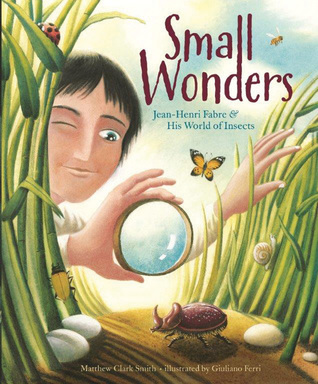
Book cover art for Small Wonders

Title: Small Wonders: Jean-Henry Fabre & His World of Insects
Author: Matthew Clark Smith
Illustrated by Giuliano Ferri
Publisher: Two Lions, 2015

Opening: Once there was a village in the sunny south of France: a village much like any other, where the cocks crowed and the church bells rang, and everyone seemed to know his or her place. Everyone, that is, but one.
At the very edge of town, behind high walls and plane trees, there stood a pink house. In the house lived an old man with beetle black eyes and a black felt hat who talked to animals. Whether he was a sorcerer, or simply a madman, no one could agree.

Why I like this book:
I love learning about people who studied nature and paved the way for us to have a better understanding of the world around us. Jean-Henry Fabre loved nature and insects and spent his life studying them and writing about them.

This book starts like a scary story with the old man in the black coat and hat coming from the pink house. We don't know who is man is and yet, the President of France is coming to visit him. How curious.

Activities for both books:
Make your own Nature Journal.

Start a Nature Journal. See what you notice throughout the year about the insects and nature around you. Here are some tips about nature journaling.

Raise a caterpillar and watch the metamorphosis process. Keep track of it in your nature journal. Then set your butterfly or moth free. This time of year, you can find eggs and caterpillars to bring in and raise on your own. You probably already know that Monarchs lay their eggs on milkweed. Did you know you might find a swallowtail egg or caterpillar on a dill plant.  I wonder where you might find a Cabbage White caterpillar?

Learn about a cocoon and a chrysalis. What are the similarities? What are the differences?


You can download and read books by Jean-Henri Fabre.

Learn more about Maria Sibylla Merian

Be sure to check out Susanna Hill's Blog where you can look for reviews by book, title, and by themes.

Friday, June 7, 2019

Perfect Picture Book Friday -- Hidden City

I woke up this morning and couldn't understand why I had Perfect Picture Book Friday blog posts in my email feed. It's only Thursday and I have a whole day to finish writing my #PPBF post. Then it hit, it really is Friday. Good thing I had the post planned out and didn't have to totally scramble. 

Cover art for Hidden City: Poems about Urban Wildlife

Title: Hidden City: Poems of Urban Wildlife
Author: Sarah Grace Tuttle
Illustrated by: Amy Schimler-Safford
Publisher: Eerdmans Books for Young Readers, 2018

Themes: Poetry, nature, mixed media art

Opening Poem:

Nesting
In the night
under the table
a mother mouse
scurries back and forth. She
rips paper
carries
rips paper
carries
rips paper
carries
forgotten paper away
to build her nest.

Why I love this book: 
Observational poetry is such a lovely way to capture little details that you notice on any given day.

Each poem focuses the mind and the eye on one element of nature. It creates curiosity to want to see it for ourselves.

There are no rhymes in sight. Not that rhyming is bad, I just enjoy poems without rhymes too.

Amy Schimler-Safford's art is beautiful, colorful, and full of the life and wonder of urban wildlife.

Activities:
  • Go outside and play.
  • Write an observational poem about something you see in nature.
  • Connect with a local community garden and get your hands dirty.
  • Make art. Use scraps of paper and garden dirt as your art media.
  • Check out Sarah Grace Tuttle's website
  • Check out Amy Schimler-Safford's website
  • Check out Jilanne Hoffman's blog post about When Grandma Gives You a Lemon Tree  Pick that book up at the library while you are out. It's a great companion to Hidden City.
  • Another book of nature poetry to pick up with this selection is Boom! Bellow! Bleat! Animal Poems for Two of More Voices written by Georgia Heard and illustrated by Aaron DeWitt. This one is great for reading together and making lots of noise.
Yesterday, (yes the real Thursday) I sat on my front stoop with my little dachshund at y side and painted the fairy house in my garden.

I spotted a daisy fairy. I wonder if a poem is in there too?

Be sure to check out Susanna Hill's Blog where you can look for reviews by book, title, and by themes. And you can check out her weekly #PPBF post along with links to many more wonderful posts here

Friday, May 24, 2019

Perfect Picture Book Friday -- Cricket in the Thicket

Tomorrow is my birthday. I wanted to find just the right book that I would want to read on my birthday. One might think I would choose a book about birthdays, or a book about Memorial Day, but if you have gotten to know me through my posts, you already realize that the book I would choose would be about nature or art or both. I have three books waiting in these categories and it was hard to to pick which one to share this week. All three were discovered during the Marvelous Midwest SCBWI Conference. When I walked through the conference book store, this book caught my eye and I was smitten with the cover.


book cover for Cricket in the thicket by Carol Murray

Title: Cricket in the Thicket: Poems about Bugs
Author: Carol Murray
Illustrated by: Melissa Sweet
Publisher: Christy Octavia Books, Henry Holt and Company, 2017

First Line:  Cricket in the thicket, cricket.

A poem from the book: 
Grasshopper Green
Grasshopper green is a munching machine,
he is built with precision and flair.

His hind legs are long and exceedingly strong,
like two springs as he zings through the air.

Four wings let him fly, let him zip through the sky,
he has jaws that are perfect for crunching.

With ears near his knees and five eyes, sure to please,
he spends most of his time simply munching.

A Very Short Description: This is a book of rhyming poems about a variety of insects.

Why I love this book: 
💚Poems about insects.
💚 Each poem is fun and observational.
💚I fell in love with the cover and then again with every illustration.
💚 I don't like all insects and there are a few in this book that I still don't like, but I enjoy knowing just a little more about each. Just because I don't like them, doesn't mean I should ignore them and not understand them. So kudos to Carol for writing about tics and mites.
💚Each page includes a poem and a fact about the insect. At the back of the book, each insect is listed with additional facts shared.
💚 This book is a Kansas State Library Notable book for 2018.
💚I had the opportunity to test a few poems out with some second graders yesterday during time in the garden. Each poem elicited discussion and sharing of previous knowledge. These second graders had monarch caterpillars in their classrooms last fall (9 months ago) to learn about the monarch caterpillar life cycle. They were sharing things they remember about the experience. Two of my favorites:  Some said, "J". It took a moment to connect the dots, but they were remembering when the caterpillar had finished eating and was getting ready to shed its skin and reveal its chrysalis. They also remembered that the newly hatched caterpillar turns around and eats its egg and may even eat its instar each time it sheds its skin. Being able to introduce insects to children through real life experience, poetry and art, helps to develop a deep understanding and appreciation of these living creatures.

Activities:
Wander around your yard, park, or neighborhood and see what bugs you can find. Then do some first hand research by asking questions and seeing if you can discover the answers. You may want to carry a nature journal to make drawing and take notes about your discoveries. I notice, I wonder, and it reminds me of.

Here are a few more questions to keep you going:
What is the big doing?
How many wings does it have?
Does it make a sound?
Did you hear it before you saw it?
What does it look like?
Where are its ears?
How close can you get?

Did you research leave you with more questions than answers? Learn more about each of the insects by checking out books from your local library.

Play Insect Bingo

Use the observations from your insect discoveries to write poems.
Information on writing rhyming couplets

Learn about the illustrator Melissa Sweet

Make your own Mixed Media Collage: A few links:
Beginner's Guide
From Meri Cherry
Mixed Media Flower Craft

Be sure to check out Susanna Hill's Blog where you can look for reviews by book, title, and by themes.

And now for something completely different. Since it's my birthday blog post, I share with you a recipe for fudge that my mother passed down to me. I made it a couple of weeks ago as frosting for my sister's birthday cupcakes. Yum! and easy to make. Think of it as nectar for humans.

Baked Fudge
1 LB. Confectioner Sugar
1/2 Cup (1 stick) Butter
1/3 Cup Cocoa
1/4 Cup Milk (I used Cashew Milk)
1/2 Cup Chopped Walnuts or Pecans (optional)
1 TBS. Vanilla

Combine sugar, butter, cocoa & milk in an ovenproof bowl
Bake for 10 minutes at 350 degrees
Add nuts and vanilla
Beat until it stats to thicken. Pour into an 11" x 7" x 2" pan or frost cooled cake or cupcakes. Let cool and enjoy.

Friday, May 10, 2019

Perfect Picture Book Friday -- Leaflets three . . .

This week it's back to nature. Spring is here in the Midwest. Trees are leafing out, the grass is green, flowers are growing, the summer birds are arriving, finding mates, and preparing nests. Bees and butterflies are flittering and searching for food. We are getting loads of rain and still have cooler temperatures, but nature and wildlife continue unabated including the plant discussed in this week's Perfect Picture Book. . .

Leaflets of three by Anita Sanchez book cover

Title: Leaflets Three, Let it Be! the story of poison ivy
Author: Anita Sanchez
Illustrated by: Robin Brickman
Publisher: Boyd Mills Press, 2014

Opening Lines: Winter woods are dark. Bare branches rattle in the icy wind. A thick brown vine creeps up a tree. Shaggy rootlets help it cling to the bark.

Themes: Nature, plants, STEM, food webs, 3-D art,

Description and Why I love this book:
An ode to poison ivy. This is one of those books that provides you with an understanding of a plant beyond our narrow itchy world of the plant. It helps a person of any age understand that while the oil in the plant may give humans a rash and make us itch, the plant itself provides food and protection for many animals.

I will admit, that just thinking about coming into contact with poison ivy makes me feel itchy, but I also know that the more I know about it the better I can protect myself from ending up with the itchy rash. The only thing that would have made this book better would have been to provide a pronunciation of the word urushiol. (That's the oil that causes a rash on humans.) That is being really nit picky and in no way takes away from the book and below, you can hear how it is pronounced.


This book takes you through a full year cycle of the plant to learn how it benefits wildlife while at the same time showing you all of its parts and colors, shapes, and sizes so that you can let it be. The back matter is written in a Q &A format and answers the burning questions you may have when you actually end up with a rash and blisters.

On the very last page, there is an artist's not about how Robin Brickman created the incredible life-like artwork for this book. So much loving attention to the plant and wildlife.

As I was putting the last touches on this post, it hit me that the title has a double meaning. "Let it be." Don't touch it because you don't want the itchy rash. Also, don't touch it because it is a beneficial plant in nature. You may not want it growing in your home garden and may need to get rid of it in places where people spend time, but allow it to grow as in natural areas so animals, birds and insects have access to its benefits.

I first learned about this book reading Melissa Stewart's Celebrate Science blog and a post by Anita Sanchez. A great post and a wonderful blog to follow if you like science and/or writing non-fiction.

Every nature center and earth science program should have a copy of this book. Then they should have a program on poison ivy and food webs.


Finally, if you want to find more cool picture books check out Susanna Hill's Blog where you can look for reviews by book, title, and by themes.

Friday, April 26, 2019

Perfect Picture Book Friday -- Dear, Agnes

Seventy-one percent of the earth's surface is made up of water. So for the last week of Earth Month, I take you to the ocean.

Book cover for Love, Agnes by Irene Latham


Title: Love, Agnes: Postcards from an Octopus

Author: Irene Latham
Illustrated by: Thea Baker

Publisher: Millbrook Press, 2018

Themes: Octopuses, STEAM, letter writing, problem solving, Earth Month

Opening lines: One day in the deep dark beneath the pier, an octopus found a large jar. She knew it would make the perfect home. But something was blocking her way.

Book Synopsis: When Agnes searches a new home, she discovers a postcard which she believes is calling her a monster, so she writes back to the author to set octopus facts straight. Thus begins the story of the giant Pacific octopus life cycle along with some ideas on how to handle uncomfortable situations.


Why I love this book:

I love epistolary stories. I loved the Jolly Postman books by Janet and Allan Ahlberg and the adult series Griffin & Sabine by Nick Bantock. Love, Agnes the one problem that the other books always caused in a library; no envelopes of flaps to get torn. But it has the same feeling of being a part of the story as you read the postcards.

Octopuses are so cool! Agnes is an older octopus and it's a story about the end of her life. This is a part of the life cycle that we often gloss over, but it is ever present. Like the Monarch butterfly who lives to lay eggs and create new life before dying, so too does the giant Pacific octopus. 

Mixed into this life of the octopus story is another story about dealing with things that bother us. Andrew's mother tells him that rather than get angry and act out, he should write it down. Little did he know that answers to his problems would come from an octopus.

Illustrations: They are beautiful. So many colors, patterns, and depth.


Epistolary defitintion


An artist I know, Betsy Mitten, combines art and science in her after school programs. One of the projects the kids do it is make Gyotaku prints with fish and octopus. It's fascinating and allows a child to see the details of the octopus and make art.


Octopus at the Maui Ocean Center
Can you find the octopus?
Finally, if you want to find more cool picture books check out Susanna Hill's Blog where you can look for reviews by book, title, and by themes.

Friday, April 19, 2019

Perfect Picture Book Friday -- Lost Words

April is Earth Month and National Poetry Month. Two things that go together as well as peanut butter and chocolate, tacos on Tuesday, rain and rainbows, worms and soil, flowers and sunshine . . . you get my drift. 

Today's Perfect Picture Book doesn't fit squarely in the picture book category of books. It's 128 pages and the acrostic poems require time and thought to allow their words and meaning to sink in and take hold of your heart and mind.  Yet, it is filled with beautiful illustrations and is a non-fiction poetry picture book.

For me, it conjures up the Wild Flowers of America book that sat on our book shelf as I was growing up (see image at the end of this post). I would browse the pages on rainy days, make drawings of the flowers with my crayons and paper, and even occasionally use it as the reference tool it was designed to be. So while neither are traditional picture books, they are books that take you into nature and without being pushed or prodded, your own imagination is sparked.

The Lost Words Book Cover

Title: Lost Words: A Spell Book

Author: Robert MacFarlane
Illustrator: Jackie Morris

Publishing Information:  2017 in the UK by Penguin Books Ltd. and 2018 in Canada and US by House of Anasasi Press Inc.

Ages: 0 - 100

Description from Amazon: In 2007, when a new edition of the Oxford Junior Dictionary ― widely used in schools around the world ― was published, a sharp-eyed reader soon noticed that around forty common words concerning nature had been dropped. Apparently they were no longer being used enough by children to merit their place in the dictionary. The list of these “lost words” included acorn, adder, bluebell, dandelion, fern, heron, kingfisher, newt, otter, and willow. Among the words taking their place were attachment, blog, broadband, bullet-point, cut-and-paste, and voice-mail. The news of these substitutions ― the outdoor and natural being displaced by the indoor and virtual ― became seen by many as a powerful sign of the growing gulf between childhood and the natural world.
Ten years later, Robert Macfarlane and Jackie Morris set out to make a “spell book” that will conjure back twenty of these lost words, and the beings they name, from acorn to wren. By the magic of word and paint, they sought to summon these words again into the voices, stories, and dreams of children and adults alike, and to celebrate the wonder and importance of everyday nature. The Lost Words is that book ― a work that has already cast its extraordinary spell on hundreds of thousands of people and begun a grass-roots movement to re-wild childhood across Britain, Europe, and North America.

Opening Lines: Once upon a time, words began to vanish from the language of children. They disappeared so quietly at first almost no one noticed -- fading away like water on the stone.

Why I love this book: I first read about this book in a post from the Children in Nature Network. Sadly, that post slipped my mind until a friend shared an article about the book with me a couple months ago. I immediately ordered it. Each time I open the pages, I turn them with awe and reverence. The title on the cover is gold embossed and the cover illustrations are a small sample of the beauty that is held within the pages.

Each lost word is given three double page spreads. The opening spread for the word is a letter jumble with the letters of the word in a unique color. The second spread includes an acrostic poem on the left and a watercolor illustration of the word on the right. The final spread is a scene depicting the word in its surrounding world.

A book worthy of book cases everywhere. Each word can become an adventure to the outdoors.

The poems are deep and full of mystery and love.

It is a book you can look at and read over and over again.

Activities and Resources:

Activities and and Explorer's Guide from the John Muir Trust

Writing Acrostic Poems

More about Acrostic Poems and using the word at the beginning, middle and end of each line.

Make a flower chain crown

Nature Journaling for Kids

Wet on wet Watercolor Painting

Bird Identification

The book from our family book shelf.

Wildflowers of America Book Cover

My Acrostic poem from this mornings visit of nine turkeys:

Tom Turkey strutting his feathers for a hen


Tom turkey struts his stuff
Under the bird feeders.
Rugged feathers raised, puffed, and shimmering in the morning light.
Kingly posture ignored by the ladies.
Every turkey more interested in breakfast,
Yet Tom persists hopefully.

Finally, if you want to find more cool picture books check out Susanna Hill's Blog where you can look for reviews by book, title, and by themes.

Friday, April 12, 2019

Perfect Picture Book Friday: Flowers Talk


Monarch Butterfly drinking nectar from purple asters photo by Sarah Tobias

You probably know that milkweed is very important to monarch butterflies because that's where they lay their eggs and then the caterpillars eat the leaves to grow big and strong so they can become butterflies. When it comes to quenching a butterflies thirst, they enjoy the nectar of many different types of flowers.

Flower Talk: How Plants Use Color to Communicate


Book Cover for Flower Talk by Sara Levine


Author: Sara Levine (www.saralevinebooks.com)
Illustrated by: Masha D'Yans (www.masha.com)

Published by: Millbrook Press, 2019

Themes: STEM,  Flowers, Nature, pollination

Ages: 6 - 11

Synopsis: A grouchy cantankerous cactus (prickly pear variety) tells the audience about how flowers use their colors, shapes, and scents to attract insects, birds, and and even mammals to help them make their seeds.

First Lines: "Hey, you! Pssst! Down Here! That's right -- I'm a plant, and I'm talking to you! But don't get too used to it. We don't make a habit of talking to humans."

Why I love this book: Pollinators are all the rage these days. We do need to save the bees and butterflies so it's a good thing we are talking about it! This books looks at the ecosystem and food web from the point of view of the flower and the symbiotic relationship between flowers and pollinators. It helps us understand the role that flowers and plants play in in the food web. This non-fiction story that will make you look at flowers in a new way.

Masha's watercolor illustrations are bright and exciting. The cactus narrator's prickly personality comes through on each page.

Excellent backmatter about flower pollination.

And really, talking to plants is fun. We should do it more often. You never know what you will discover.

A Q&A with Sara Levine

The blog post where I learned about this book.

Activities:

Create your own flower or nature scavenger hunt. Use the same one each season and see what things are the same and what things are different.

Take a hike in your local parks or forest preserves.

Start a Nature Journal

Play with watercolors. I found this little Nature Sketchbook that is easy to take with me and works well with all types of art mediums. Great for making art on the go or as a nature journal. I love this little watercolor set because it's easy to take with you and has lots of colors. A watercolor brush that holds water makes painting on the go super easy.

Make your own pollinator garden or participate in a local community garden.
A pollinator garden can be as small as a pot of native plants on your balcony or front porch. Make sure that you choose flowers that are native to where you live. Those flowers will provide the best food sources for native insects and birds.

drawing of a Nasturtium Fairy by Sarah Tobias

And . . . If you want to find more cool picture books check out Susanna Hill's Blog where you can look for reviews by book, title, and by themes.

Friday, September 21, 2018

Under the Sea, Three Books You Should See

Well, it may officially be fall here in the Midwest, but that doesn't stop me from thinking about water and the ocean.

I love the ocean. I love water. I grew up on Lake Michigan and have gone in swimming soon after the last of the ice was gone for the season. Throughout my youth, we played in the waves and tooled around on little boats, fished, and watched many sunsets. Sadly, I never took the love of water any further than being able to swim and spend time there.

I remember the first time I swam in the ocean, I was afraid to get off the raft because I could see these strange creatures lying around on the bottom. (Sea cucumbers and starfish) I was stunned when I held a starfish and it suctioned itself to my hand at my aunt and uncle's cabin outside Seattle, Washington.

The next time I was in the ocean, I was quite a bit older and in Hawaii. Everything is so blue there. From shore, we watched dolphins leaping and jumping. I saw humpback whales and sea turtles. I was truly in love and awe of what the ocean had to offer. We went on whale watches, I read books, I listened to everything that anyone had to tell me about ocean life. That was vacation time, then I would go back to the reality of living in the Midwestern cornfields with the closest large body of water 65 miles away. That doesn't sound very far, but when you have a job and family obligations, it takes planning to spend a day at the beach.

The most recent body of water I spent my time in was the Kishwaukee River. We had a great time, but my knees didn't even get wet. We saw frogs and polliwogs, minnows, mussels, macro invertebrates, and damselflies landed on my arm. There is so much to see and learn about in any water.
This polliwog is almost through metamorphosis. It still has a tail and its eyes have not moved all the way up on its head.

When I can't be in the water, it's fun to read about it. Here are three titles that take you deep into the sea with courageous people who changed our understanding of the ocean.


She fell in love at the aquarium. With the sharks. She was told this wasn't a career for a woman. She didn't care. Her love of sharks, drove her toward her passion. This beautiful picture book biography by Jess Keating about Eugenie Clark offers an overview of her life as well as a look into the lives of sharks. She started the Mote Aquarium in Sarasota, Florida. Don't miss the authors notes and added information at the end of the book. You can also check out the article about her from the Mote Aquarium.


I discovered this book at the library recently. It is quite a story or two courageous men who wanted to discover what was deep in the ocean. When they met, they worked together to find a way to see the deep blue sea. As I read the story of the bathysphere going deeper and deeper in the ocean, my heart rate went up, and I felt the thrill and fear of this dangerous journey. Exhilarating and scary. Be sure to read the author and illustrator notes to learn mire about their research in creating this wonderful book.

Even with the Bathysphere, the world deep in the ocean is remains largely uncharted territory.


Since 1964, Alvin began making dives and more and more discoveries in the ocean. Michelle Cusolito takes you on a day trip down in Alvin a deep sea submersible. Her simple text reads like a poem and her use of onomatopoeia bring the sounds of the journey to life. Nicole Long's illustrations are beautiful and full of detail. The back matter provides details bout the author and illustrator's journey to create their book, facts about Alvin, a glossary, and details about the organisms seen on the trek to the bottom of the sea. Such a lovely book taking us to a world within our world.

As an additional note, these books were written and illustrated by women. It is wonderful to see more and more children's literature being published by women.